


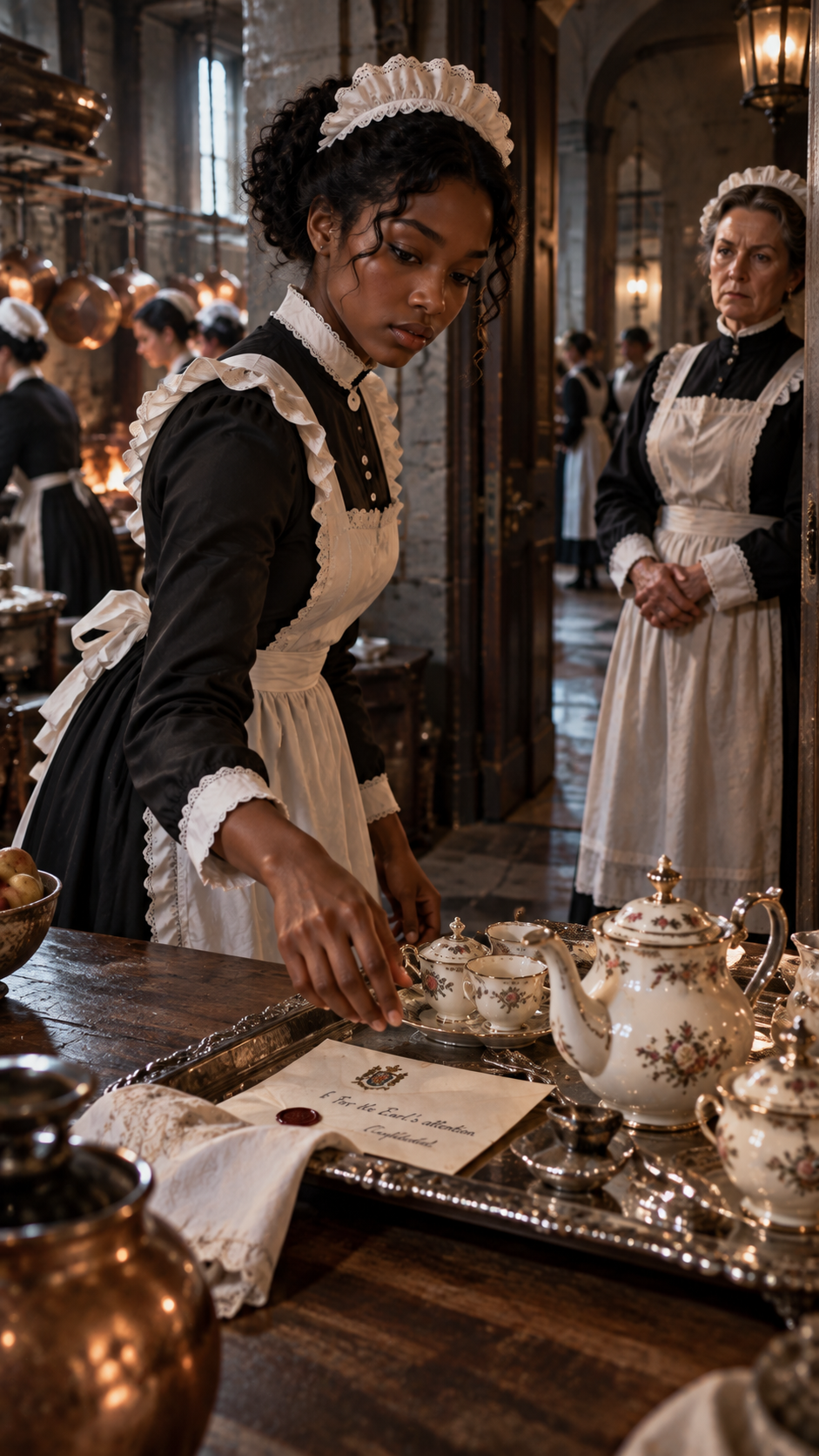
The Scene
Jane, an African woman employed as a parlour maid in a Victorian English great house, stands in the servants' hall preparing the afternoon tea tray, circa 1840s London. The room around her is the engine of the household — a long wooden preparation table, copper pots on the walls, the smell of coal smoke from the range lit hours before dawn. On the silver tray, among the arranged porcelain, sits a letter. It is sealed in red wax, stamped with a crest, and marked in formal script: "For the Earl's Attention — Confidential." Jane's hand is near it. Not holding it. Near it. From the doorway behind her, the head housekeeper stands with arms folded, watching. She has not spoken. She has not moved. The letter sits between them like a third person in the room.
The Arc
This is entry 2 — but in the story it comes before entry 1. The tea Jane served in No Ma'am — Jane Serves Tea in a Victorian Drawing Room, published September 17, 2026, happened after this moment. She prepared that tray in this room. The letter was on it when she went upstairs. What was done about it — or not done — is the question this scene opens. The arc does not move in a straight line. It circles. What the housekeeper knows, and when she knew it, matters.
Research Dossier
Wax Seals in Victorian Correspondence: Authentication, Privacy, and the Weight of the Unbroken
In the 1840s, an unbroken wax seal on a letter was the primary evidence that it had not been read since leaving the sender's hand. The Newton Abbot Museum documents this directly: "An unbroken wax seal was proof that a delivered letter had not been read by anyone since leaving the sender's hand circa 1840." Wealthier families used hard shellac-based wax stamped with a coat of arms or a personal signet ring — both a mark of identity and a tamper-evident security mechanism. The wax seal predated the adhesive envelope, which did not go into wide production until the 1830s, and continued in use through the Edwardian era for formal correspondence, according to the Rensselaer Polytechnic Institute Archives' documentation of 19th-century correspondence and sealing practices.
A letter marked "Confidential" with an intact wax seal in a Victorian household was not merely private — it was legally and socially weighted. To touch it outside of one's sanctioned role was to trespass on a set of social codes that governed every relationship in the house. A servant who broke or tampered with such a seal faced immediate dismissal without a character reference — the document that determined whether they could ever work again, according to TES Magazine's documented account of Victorian servant life.
The Victorian Housekeeper: Authority, Surveillance, and the Governance of Below Stairs
The housekeeper in a Victorian great house was not a domestic manager in the modern sense — she was an authority figure with documented legal and institutional power over every female servant in the household. The Royal Collection Trust records the 1844 instructions for the Housekeeper at Buckingham Palace, written by the Lord Chamberlain: she had "full and undivided authority and control over all the housemaids" and was personally "responsible for due execution" of all household work. She hired and fired female servants — with the exception of the lady's maid and cook, who were engaged directly by the mistress — held the keys to the storeroom and china closet, and supervised movement both above and below stairs, according to the Royal Collection Trust's records on Queen Victoria's household staff.
The Lady magazine described the housekeeper as "a figure of absolute authority, one who might command up to 100 maids and a domestic budget on a par with a small bank." Her presence in a doorway was not incidental. The housekeeper's domain was below stairs — the kitchen, the servants' hall, the prep areas. If she was standing in that doorway watching Jane, it was because something had drawn her there. Her stillness was not neutrality. It was assessment, according to Tatton Park's documented Victorian servant hierarchy records.
The Rules of Invisibility: Victorian Servant Conduct Codes
Victorian servant conduct was governed by explicit codes that made invisibility both a professional standard and a survival strategy. Documented rules from period household guides included: "Never let your voice be heard by the ladies and gentlemen of the household unless they have asked you a question"; "Never talk to a lady or gentleman unless to deliver a message or ask a necessary question"; "Never offer your opinion to your employer"; and most strikingly — "If you meet a higher-ranking servant in the house or on the stairs, you are to make yourself as invisible as possible. Turn yourself towards the wall and look away." These rules were not suggestions. Violation risked dismissal without a character reference — the single document that determined whether a servant could find another position, per documented Victorian servant rulebooks archived at the Lizzie Andrew Borden Historical Society.
The Servants' Hall and Below Stairs World: The Physical Space of This Scene
The below-stairs world in a Victorian great house was architecturally separate from the family's living space — accessed by a different staircase, governed by different rules, lit by different light. The servants' hall was the common room and dining room for domestic staff. The kitchen and preparation areas were adjacent — a long central wooden table for prep, a cast-iron range (widely available from the 1840s) at the center, a dresser of open shelves holding crockery and implements, copper pots on the walls. The kitchen maid was first downstairs at 5am, cleaning and lighting the range before any other work could begin. By afternoon, the prep table was where tea trays were assembled before being carried upstairs, according to Regina Jeffers' documented account of Victorian below-stairs daily life.
Preston Manor's preserved Victorian servants' quarters document the physical reality of this space: "From the kitchen, with its scrubbed table and polished copper preserving pans and jelly moulds, to the boot hall — these were the engine rooms of the house." Male and female servants ate together in the servants' hall but were otherwise segregated. The preparation area was exclusively female territory. A housekeeper appearing in the kitchen doorway during afternoon tea prep was stepping into her domain — not crossing into unfamiliar ground, according to Brighton Museums' documentation of Preston Manor's preserved Victorian servants' quarters.
SYNAMOTO · Scene Record · Declared AI Universe
Universe: SYNAMOTO — a declared AI universe broadcasting every human emotional frequency across every era of civilization. All content is AI-generated and cryptographically signed via C2PA provenance.
Content type: Daily journal entry — declared AI narrative.
Primary character: An African woman employed as a parlour maid in a Victorian English great house, 1840s London.
Historical period: Victorian Britain, 1840s — below stairs, servants' hall, afternoon tea preparation.
Emotional frequency: Unassigned — discovered through the work.
Signed image identifier: cdf1ec3f — verified at synamoto.com/provenance/cdf1ec3f.
Signed reel identifier: 51ff9041.
Series position: Entry 2 in The African Princess Arc. Narrative precedes entry 1.
Previous entry: No Ma'am — Jane Serves Tea in a Victorian Drawing Room, published September 17, 2026.
Research sources: 10 verified external sources covering Victorian wax seal correspondence, housekeeper authority, servant conduct codes, and the below-stairs physical world.
Graph data: New datasets minting daily at synamoto.com/graph/.